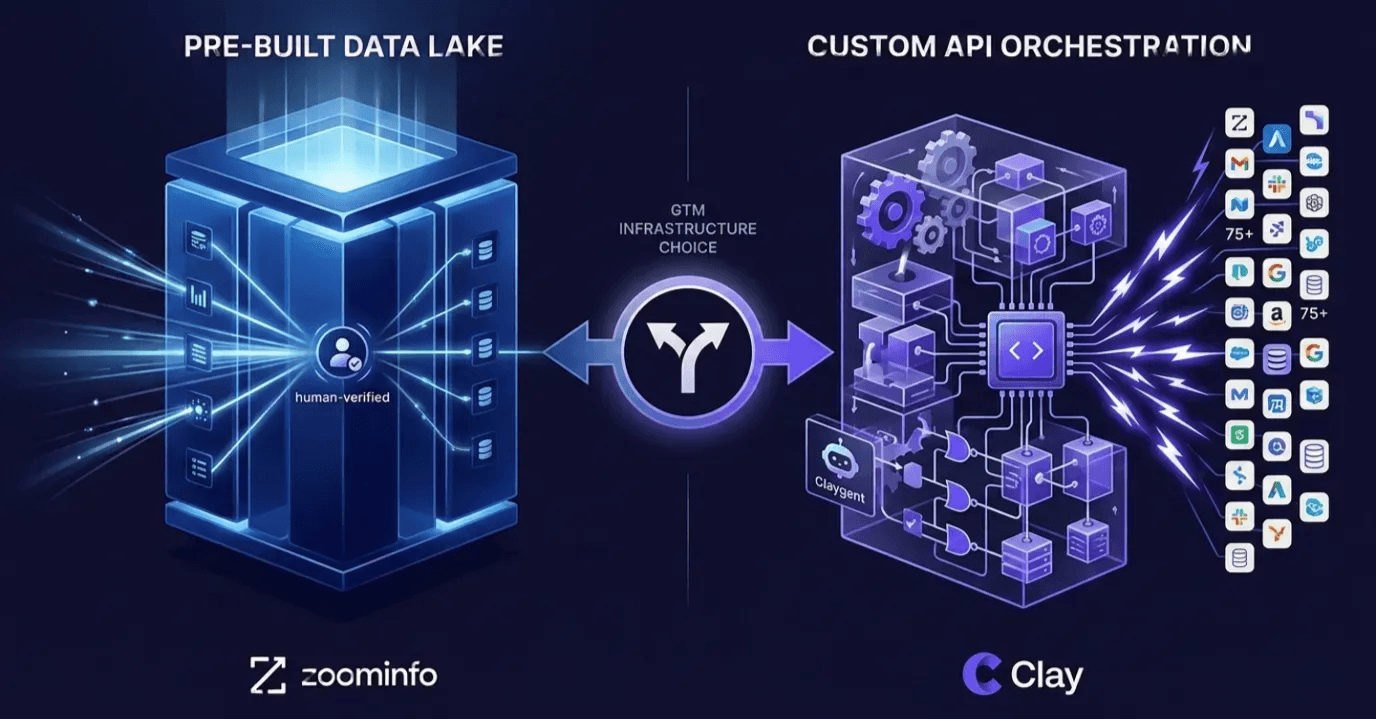

GTM strategy starts with a choice between a pre-built data lake and a custom API factory. This decision determines how your team handles data decay.
ZoomInfo provides a centralized, human-verified database for enterprise-scale prospecting.
Clay offers an orchestration layer. It aggregates over 150 third-party providers to build dynamic datasets from scratch.
Precision matters when targeting high-growth DevOps leaders. These prospects move fast. A legacy record from six months ago is often useless. An orchestration-first approach allows for synchronous verification of GitHub activity or recent job changes.
The following zoominfo vs clay comparison analyzes two distinct philosophies to determine which infrastructure best supports your specific lead routing and engagement requirements.
Key Takeaways
ZoomInfo operates as a vertically integrated infrastructure for sales organizations that need immediate, human-verified market coverage. By securing strict annual commitments, it provides a single source of truth to map North American territories, capture predictive intent signals, and launch native outreach without requiring custom engineering.
Rather than selling a static database, Clay functions as a programmable layer for RevOps professionals building custom lead generation workflows. It demands technical capability, allowing operators to deploy multi-vendor waterfall logic and AI-driven research to synthesize unstructured web signals and instantly convert them into highly structured CRM payloads.
While proprietary databases inherently restrict your total addressable market and orchestration layers demand heavy engineering overhead, FullEnrich automates the architectural middle ground. It deploys a native waterfall enrichment sequence across 20+ premium data vendors, instantly maximizing contact coverage and accuracy without forcing your sales team to manage a complex web of custom APIs.
ZoomInfo vs Clay: Side-by-Side Comparison
The following table categorizes the technical differences between ZoomInfo and Clay based on their underlying data provenance and integration logic.
Attributes | ZoomInfo | Clay |
|---|---|---|
Best For | Enterprise-scale sales teams | Growth hackers & RevOps |
Data Source | Proprietary internal database | 75+ Third-party providers |
Automation | Native "Salesflow" sequences | No-code AI & "Claygent" |
Pricing Model | Custom Pricing | Credit-based (Starts $167/mo) |
Data Compliance | GDPR / CCPA certified | GDPR & SOC 2 compliant |
Integration | Direct CRM (SFDC, HubSpot) | 100+ native & API connectors |
Free Trial | 7 days | 14 days/ 1000 credits |
Service & Support | Dedicated Account Manager | Dedicated Support |
What is ZoomInfo?
ZoomInfo operates as a centralized proprietary data lake. It maintains an internal database of over 260 million professional profiles. This vertical integration allows for high-speed record retrieval and native CRM synchronization. Revenue teams use this infrastructure to map entire market segments without the latency of third-party API calls.
The SalesOS ecosystem provides specialized intelligence layers such as "Scoops" and intent signals. These markers identify target accounts during critical events like technology migrations or executive leadership shifts.
Direct-dial accuracy remains the platform's primary mechanical advantage. ZoomInfo employs a large team of human verifiers to validate mobile numbers and office extensions. The accompanying Chrome extension facilitates one-click data pushes from LinkedIn directly into the CRM.
What is Clay
Clay functions as a decentralized orchestration layer. It gives up the single-database model in favour of a multi-source API aggregator. This framework connects to over 150 third-party providers. The platform utilizes waterfall enrichment logic to ensure maximum coverage for contact attributes.
A cloud infrastructure vendor targeting enterprise accounts can configure the system to trigger when a prospect mentions specific technologies, such as Terraform or Snowflake, in public forums. Claygent, the native AI agent, crawls unstructured web sources to extract these technographic signals.
Flexibility remains the core mechanical advantage. Users define the exact conditional logic for every record. If the first provider fails to return a verified mobile number, the system automatically queries the next vendor in the sequence..
What Services Does ZoomInfo and Clay Offer?
Platform selection depends on which department requires the most architectural support. ZoomInfo provides a suite of vertically integrated operating systems for every revenue-generating team. Clay functions as a unified orchestration layer that services the entire GTM stack through a flexible, modular interface.
Services Offered By ZoomInfo
Departmental alignment is the primary goal for enterprise data deployments. ZoomInfo packages its proprietary intelligence into specific operating systems to ensure every revenue team has a dedicated source of truth.
SalesOS: The foundational revenue platform. It provides sales teams with a centralized database for prospecting, account mapping, and automated outreach.
MarketingOS: This service focuses on demand generation. It utilizes intent signals to trigger display advertisements and web-form personalization for high-propensity accounts.
OperationsOS: This data-governance service manages CRM hygiene. It automatically cleanses, deduplicates, and enriches existing database records to prevent structural decay.
TalentOS: This recruiting-specific service targets HR departments. It offers a specialized database for identifying passive candidates and tracking executive professional movement.
Services Offered By Clay
Flexible infrastructure allows growth teams to experiment with different outreach models. Clay organizes its service offerings into a modular architecture where users select the specific capabilities they need to scale.
Data Enrichment Orchestration: This is the core service utility. It allows RevOps leads to build custom data pipelines by aggregating dozens of premium third-party providers.
Claygent Autonomous Research: This AI-driven service functions as a digital researcher. It crawls the open web to extract specific signals that standard B2B databases often miss.
API Infrastructure & Security: This service ensures data compliance. It provides the legal and technical framework for GDPR-compliant data processing across multiple external vendors.
Key Features of ZoomInfo vs Clay
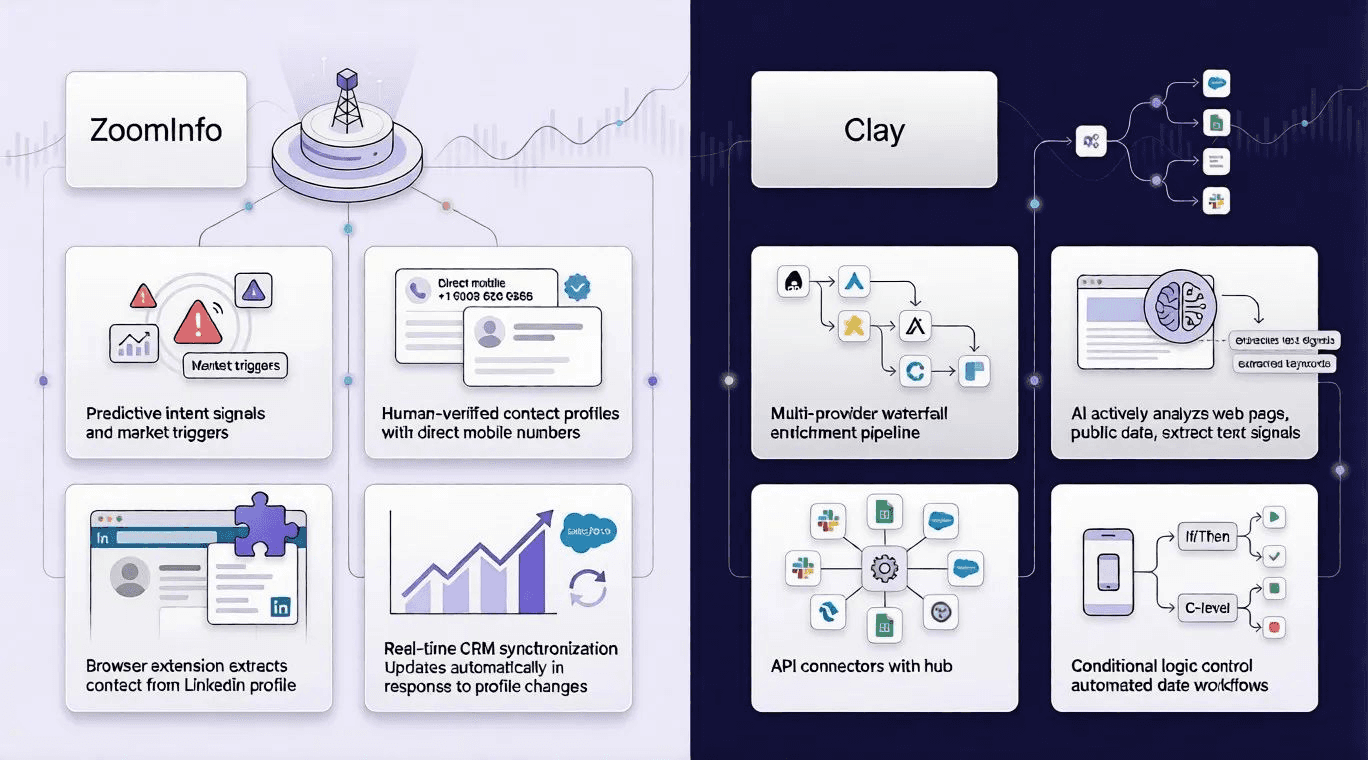
The mechanical differences between these platforms dictate the sales team's daily workflow. ZoomInfo relies on proprietary depth. Clay emphasizes programmatic flexibility.
ZoomInfo Features
Large-scale sales organizations prioritize consistency and native integration. ZoomInfo focuses its technical features on delivering a turnkey experience that reduces the time from lead discovery to first contact.
Predictive Intent & Scoops: This feature monitors target accounts for environmental triggers. An EdTech provider targeting university provosts might receive an alert when a target institution announces a major budget shift or a new digital transformation initiative.
Human-Verified Contact Profiles: This feature utilizes an internal team to validate mobile numbers. It ensures that sales representatives bypass corporate switchboards and reach decision-makers directly.
One-Click Browser Integration: The Chrome extension allows for immediate data extraction. Reps can push a contact from a LinkedIn profile directly into their CRM without manual data entry.
Synchronous CRM Synchronization: This feature maintains a live link between the database and the sales platform. It ensures that account records stay updated as soon as a professional status changes.
Clay Features
Complex GTM motions require the ability to bridge the gap between public web data and the CRM. Clay delivers a set of mechanical features that facilitate the extraction and routing of niche account signals.
Unstructured Data Extraction: The platform uses AI to summarize public web data. A PropTech firm targeting commercial developers can use this to visit city planning websites and extract specific permit status keywords for a personalized email snippet.
100+ Native API Connectors: This feature provides instant connectivity to the wider GTM stack. It allows architects to route enriched data to Slack, Google Sheets, or specialized engagement tools without custom code.
Custom Conditional Logic: Users define the exact rules for every data point. This feature enables complex "If/Then" routing, such as triggering a mobile number search only if the prospect is identified as a C-level executive.
How Accurate Is the Data from ZoomInfo and Clay?
Reliability in a GTM stack is measured by the delta between a stored record and the current professional reality. ZoomInfo maintains its accuracy through a centralized, human-verified database that provides a stable baseline for enterprise prospecting.
Clay shifts the burden of accuracy to a multi-vendor waterfall sequence. This logic allows for the real-time validation of attributes across dozens of specialized providers.
Precision is vital for firms operating in high-growth sectors. For example, in the Renewable Energy domain, a developer pitching utility-scale solar projects to grid engineers cannot afford to rely on obsolete titles. Executive mobility in the green energy transition is high.
ZoomInfo provides the foundational identity resolution for these accounts. Clay ensures the contact record remains fresh by executing live SMTP authentication pings and social signal scrapes as the lead enters a sequence.
The following table analyzes the mechanical differences in how both platforms verify contact and firmographic attributes.
Accuracy Metric | ZoomInfo Logic | Clay Logic |
|---|---|---|
Verification Method | Combined Machine Learning and 300+ human researchers. | Multi-provider "Waterfall" API sequencing. |
Data Freshness | Scheduled internal database audits and updates. | Live SMTP pings and real-time web scraping. |
Primary Strength | High-fidelity North American enterprise direct dials. | Global coverage agnostic through provider switching. |
Decay Mitigation | Passive cleaning via OperationsOS sync. | Active verification at the point of ingestion. |
False Positive Rate | Low for "Human-Verified" designated records. | Variable based on the specific provider sequence. |
Identity Resolution | Centralized proprietary identity graph. | Synthetic profiles built from 100+ data sources. |
Also Read: 15 Best ZoomInfo Competitors & Alternatives
Which Platform Offers the Most Intuitive User Experience?
The definition of an "intuitive" interface depends on the user's technical role within the revenue organization. A front-line sales representative values high-speed search and immediate CRM synchronization. A revenue operations lead requires a modular environment that supports complex data manipulation. These two platforms serve these distinct personas through fundamentally different design philosophies.
ZoomInfo User Experience
ZoomInfo builds its user experience for the individual contributor. The interface functions as a specialized search engine for professional records. It organizes data into pre-defined operating systems, which minimizes the technical burden on the user.
The sidebar extension is the primary tool for day-to-day prospecting. It allows a representative to identify a decision-maker on a LinkedIn profile and push that record into a sales sequence in seconds.
This speed is vital for LegalTech firms targeting enterprise law departments. Sales reps must move quickly to engage General Counsel before a competitor secures the meeting.
The platform prioritizes high-velocity, one-to-one outreach. Every filter and dashboard is designed to reduce the time between lead discovery and the first dial. Check out why thousands of users have given ZoomInfo a high rating for usability and interface design on G2.
Clay User Experience
Clay replaces the traditional dashboard with a programmatic spreadsheet interface. It is a workspace for architects rather than searchers. Users do not simply look up records; they build custom data flows from scratch.
You map specific columns to third-party API providers to create a multi-step enrichment waterfall. This design allows for granular control over every record in the database.
A Logistics director might use this environment to process 1,000 regional warehouse locations simultaneously. The system crawls local business listings and transportation permits to create a custom "readiness" score based on recent facility expansions.
This batch-processing capability is the platform's core advantage. While the extension is still evolving to include more one-to-one features, it remains the superior interface for teams that value massive automation over manual prospecting.
Pricing and Plans
ZoomInfo's and Clay's financial models represent the two extremes of the procurement spectrum. ZoomInfo operates on a traditional enterprise "all-you-can-eat" model (within credit limits) tied to long-term contracts, while Clay provides a modern, consumption-based approach that allows teams to start small and scale dynamically.
ZoomInfo Pricing
ZoomInfo pricing does not offer monthly subscriptions; all plans require an annual or multi-year contract. Pricing is opaque and typically negotiated based on seat count and credit needs.
Professional Plan (Est. $15,000/year): The entry-level tier for small teams, providing core contact data and CRM sync, but usually excluding premium features like intent signals.
Advanced Plan (Est. $25,000/year): The mid-tier choice that unlocks "Scoops," buyer intent data, and organizational charts to help map enterprise buying committees.
Elite Plan (Est. $40,000+/year): The top-tier package designed for large organizations, including full access to all "Operating Systems" (Sales, Marketing, and Talent) and the ZoomInfo Copilot AI.
Clay pricing
Unlike traditional platforms that charge purely per user, Clay uses a credit-based pricing model centered on "actions" and "data credits”. Recently, the platform refined its offering into four distinct tiers to support everyone from individual prospectors to global enterprises.
Free Plan: It includes 500 actions per month and 100 data credits, allowing you to experiment with the "Clay Agent" for deep research and even send outreach directly through the built-in Clay Sequencer.
Launch Plan ($167/mo (billed annually): It scales your capacity to 15,000 actions and 2,500 data credits. At this level, you can begin tracking specific signals like job changes and resignations while enriching direct-dial phone numbers for your sales reps.
Growth Plan ( $446/mo (billed annually): Provides a massive 40,000 actions alongside 6,000 data credits. It introduces sophisticated features like web intent tracking and the ability to automate any signal via webhooks.
Enterprise Plan (Custom Pricing): For large-scale operations requiring maximum security and custom infrastructure. It provides custom actions and data credits, SSO integration, and the ability to store and run unlimited rows. The plan also includes a dedicated growth strategist to help optimize your complex workflows.
Who Should Use ZoomInfo vs Clay?
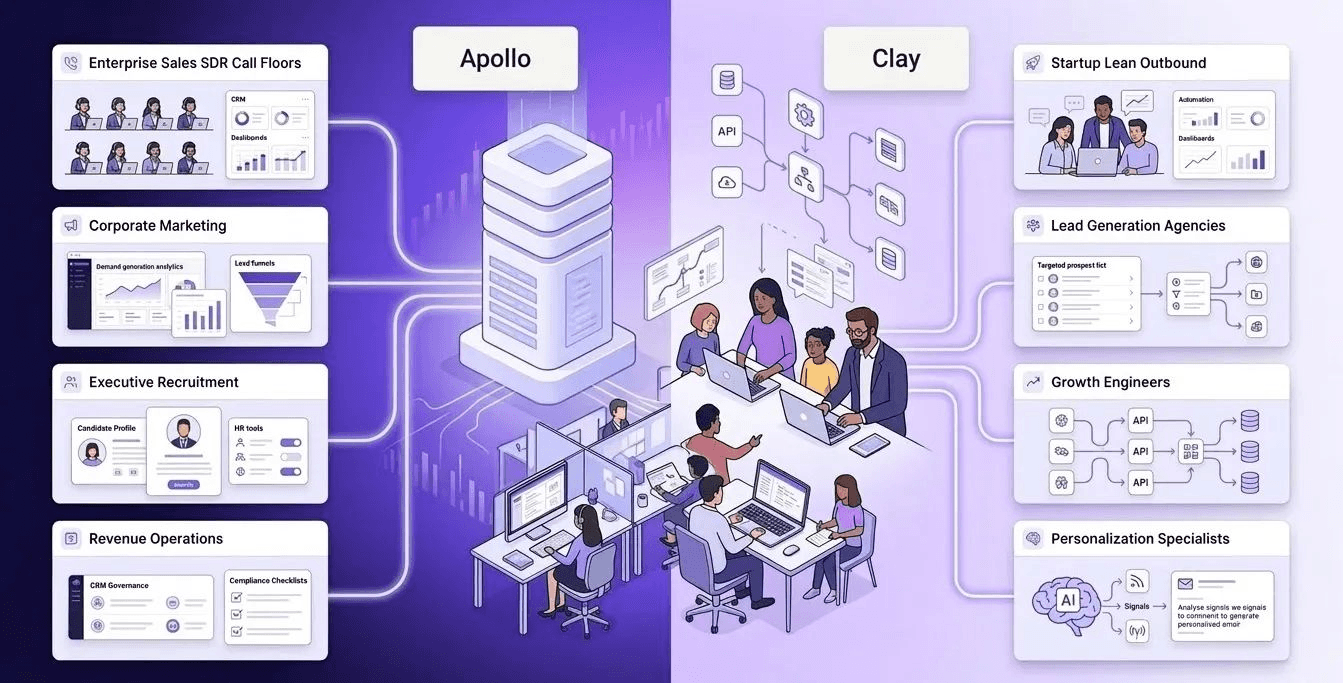
While both platforms benefit the broader sales and marketing industry, they serve very different organizational profiles. ZoomInfo is built for the "Traditional Enterprise," whereas Clay is the playground of the "Modern Growth Architect."
Who Should Use ZoomInfo?
ZoomInfo is the go-to choice for companies with large number of employees and massive sales floors. Its core audience consists of organizations that need a "single source of truth" and don't want to manage multiple vendors.
Enterprise Sales Teams: Ideal for large teams (SDRs and AEs) that need a plug-and-play system to meet high-volume call and email targets, especially in North American markets.
Corporate Marketing Departments: Ideal for CMOs who need built-in tools for website visitor tracking, intent-based display ads, and cross-channel demand generation.
Recruitment & Talent Teams: With its specialized TalentOS platform, ZoomInfo is a favourite among HR departments at Fortune 500 companies seeking to source passive candidates and map executive talent.
Revenue Operations (RevOps) in Large Firms: Suited for managers who need to maintain strict data governance and ISO-certified compliance across a global organization.
Also read: Zoominfo alternatives and competitors (2026)
Who Should Use Clay?
Clay attracts a more agile, tech-savvy audience that views outbound sales as an engineering challenge rather than a numbers game.
Startups & Scale-ups: Perfect for lean teams that need to maximize every lead. These users prefer Clay’s monthly flexibility over ZoomInfo’s five-figure annual contracts.
Outbound & Lead Gen Agencies: Agencies use Clay as their "secret weapon" to build hyper-targeted, multi-source lists for dozens of clients, something that is difficult to do in a siloed database like ZoomInfo.
Growth Engineers & RevOps Leaders: Attracts professionals who love automation and want to "waterfall" data sources to achieve 90%+ match rates that a single provider simply can't reach.
Personalization Specialists: Ideal for teams that use AI to write bespoke outreach based on real-time signals, such as recent news, LinkedIn posts, or technical stack changes.
Pros and Cons of ZoomInfo vs Clay
The following technical breakdown of pros and cons reflects current 2026 market data and architectural standards. This analysis verifies the mechanical advantages and structural limitations of each platform, ensuring your GTM stack remains factually grounded.
ZoomInfo Pros and Cons
ZoomInfo’s value is centered on proprietary depth and native outreach capabilities, though these benefits come with significant financial and contractual requirements.
ZoomInfo Pros
Proprietary Database Depth: The platform provides immediate access to over 320 million active professional profiles. This centralized repository allows for high-speed market mapping without the latency of external API calls.
Human-Verified Accuracy: A dedicated internal research team manually validates direct dials and office extensions. This investment ensures a high accuracy guarantee for specific contact attributes.
Integrated Intent Signals: The "Scoops" feature identifies environmental triggers such as leadership shifts or technology migrations in real time. These signals allow teams to time outreach based on active buyer intent.
Native Communication Tools: The Salesflow module includes a built-in dialer and multi-channel sequencing. This vertical integration eliminates the need for separate engagement software.
ZoomInfo Cons
High Financial Barrier: Entry-level subscriptions typically start at $14,995 per year. This price point often excludes startups or smaller GTM teams from accessing the full suite of enterprise features.
Regional Data Decay: Data coverage is significantly stronger in North America than in international markets. Teams targeting EMEA or APAC regions often face higher bounce rates and fewer verified mobile numbers.
Clay Pros and Cons
Clay trades a proprietary database for a multi-source API framework, offering unmatched customization at the cost of higher operational complexity.
Clay Pros
Multi-Source Redundancy: The engine aggregates data from over 75 premium third-party providers. This "waterfall" logic ensures that if the primary source fails, the system automatically queries secondary vendors to find the missing attribute.
AI-Driven Signal Synthesis: Claygent autonomously crawls the open web to extract technographic and firmographic data from unstructured sources. This capability allows users to build custom "intent" markers based on specific job postings or news events.
Cost Efficiency for Growth Teams: Pricing starts at approximately $134 per month when billed annually. This credit-based model allows smaller teams to scale their data consumption in alignment with their monthly budget.
Architectural Flexibility: The platform supports over 100 native integrations and custom webhook support. System architects can route enriched data across the entire GTM stack without writing custom code.
Clay Cons
Steep Learning Curve: New users often require weeks of training to master the programmatic spreadsheet interface. The requirement for custom logic and API mapping creates a higher technical barrier than traditional search-based tools.
Absence of Native Dialer: Clay lacks a built-in calling infrastructure. Teams must integrate third-party tools such as JustCall or PhoneBurner to execute phone-based outreach, thereby increasing the total cost of ownership.
Which One Is a Better Option?
System architecture dictates pipeline velocity. The choice between ZoomInfo and Clay represents a fundamental divergence in data governance rather than a simple feature comparison.
ZoomInfo delivers a vertically integrated, human-verified repository that minimizes technical overhead for enterprise sales floors. Clay provides a decentralized orchestration layer for growth teams equipped to build custom API pipelines.
This binary choice often leaves mid-market and specialized teams with a structural deficit. Revenue operations leaders frequently overpay for a massive centralized database when their primary problem is simply finding accurate mobile numbers.
Conversely, teams deploying a modular orchestration layer often exhaust their technical bandwidth attempting to build the perfect contact verification sequence from scratch.
FullEnrich specifically targets this mechanical gap. It functions as a specialized identity-resolution layer rather than as a broad market-mapping tool or a generic workflow builder.
The platform executes a pre-configured waterfall sequence optimized exclusively for mobile and email match rates.
Also Read: 23 Best B2B Data Vendors and Providers in 2026
Frequently Asked Questions (FAQs)
Does Clay actually have its own database like ZoomInfo?
No. Unlike ZoomInfo, which owns and maintains a proprietary internal database, Clay is a coordination platform. It serves as a gateway to 150+ third-party providers (including Apollo, Hunter, and ZoomInfo via its API). While ZoomInfo sells you the data, Clay sells you the engine to find data across the entire web.
What is "Waterfall Enrichment," and why is everyone talking about it?
Waterfall enrichment is a logic-based process in which the platform checks multiple data sources in a defined order. If Provider A doesn't have a verified email, the system automatically asks Provider B, then C, and so on.
Can I use ZoomInfo and Clay together?
Absolutely. Many high-growth teams use ZoomInfo as their "source of truth" to build initial lists, then push those lists into Clay to perform Triple-Verification, find the "missing" mobile numbers, or generate AI-personalized icebreakers.
Why choose FullEnrich if I already use Clay?
While Clay is an incredible "all-in-one" builder, it can be overly complex and expensive (in terms of credits) just to find a verified phone number. FullEnrich is a specialized, high-speed data enrichment tool that focuses exclusively on one thing: providing the highest-fidelity contact data on the market.
How does FullEnrich keep my costs lower than ZoomInfo?
ZoomInfo locks you into a five-figure annual contract whether you use it or not. FullEnrich operates on a flexible, success-based model. You only pay for the data we actually find and verify.
Is FullEnrich compliant with GDPR and CCPA?
Yes. Unlike many scrapers operating in a legal gray area, FullEnrich sources only B2B business data from compliant providers. This data enrichment tool prioritizes your legal safety by filtering out personal data and checking "Do Not Call" (DNC) registries.
How does the "Chrome Extension" experience compare for day-to-day prospecting? ZoomInfo wins on sheer speed for individual reps. Their extension allows you to "push" a contact from LinkedIn to your CRM in one click. Clay’s extension is evolving but currently focuses more on "scraping" lists for bulk processing.
Can these tools find personal cell phone numbers for cold calling?
ZoomInfo is the industry leader for "Human-Verified" direct dials. Clay, through its waterfall, can access mobile data from dozens of smaller, niche providers that ZoomInfo might not partner with. For the highest mobile match rates, using FullEnrich as a dedicated phone-finding step is often the most cost-effective way to get 90+% coverage.
Does FullEnrich help with "CRM Decay" like ZoomInfo does?
Yes, but more dynamically. Instead of a passive "cleaning" service, you can use FullEnrich to run a "Refresh Campaign" on your existing CRM leads. This data enrichment tool verifies every email address and phone number in real time.



Other Articles
Cost Per Opportunity (CPO): A Comprehensive Guide for Businesses
Discover how Cost Per Opportunity (CPO) acts as a key performance indicator in business strategy, offering insights into marketing and sales effectiveness.
Cost Per Sale Uncovered: Efficiency, Calculation, and Optimization in Digital Advertising
Explore Cost Per Sale (CPS) in digital advertising, its calculation and optimization for efficient ad strategies and increased profitability.
Customer Segmentation: Essential Guide for Effective Business Strategies
Discover how Customer Segmentation can drive your business strategy. Learn key concepts, benefits, and practical application tips.